Guardsman-A-Day: Consider: the Autocannon (continued): Hawley Gun, portside view. A mechanically simple design.
I don't know if you have this on your blogroll or not (unless you're Admiral Drax, who is my gateway to 'Guardsman-A-Day'). But this is unlike all of our other blogs.
This blog is, quite simply, art. In and of itself.
What you get is not necessarily a guardsman per se, but a slightly abstract window on one Astra Militarum deployment.
The regiment appear to have been not entirely standardised in the first place and appear to have been deployed and then forgotten about by the DM. The upshot of which is, as you browse the blog that bits are variously trying to remain staunchly Iggy, other bits are going feral and there's a hint that some of the farest flung bits might actually be turning into the enemy that they were sent to Litmus Prime to counter.
I suspect (and hope) that we are not going to get a definitive answer any time soon.
Some of the modelling and colourschemes might not be to everyone's taste or idea of what the IG aesthetic should be, but I think that this is part of this piece of art's engaging mechanism. As you browse through it, you never know quite what you'll see next (ie a model where every single component has come from a different kit), let alone what it might be.
Intriguing and well worth a Liebster.

Monday, 13 October 2014

Thursday, 9 October 2014
Not breaking my own rules for 2014. But if I did...
https://www.youtube.com/watch?v=gYA71Ircz1I&src_vid=DZXXC1xUPDc&feature=iv&annotation_id=annotation_584469
Friday, 19 September 2014
902 Div Staff Officers

New FW figures on scibor bases. The officer in the senior officer's helmet is brandishing a Heresy miniatures las pistol with integral sight.
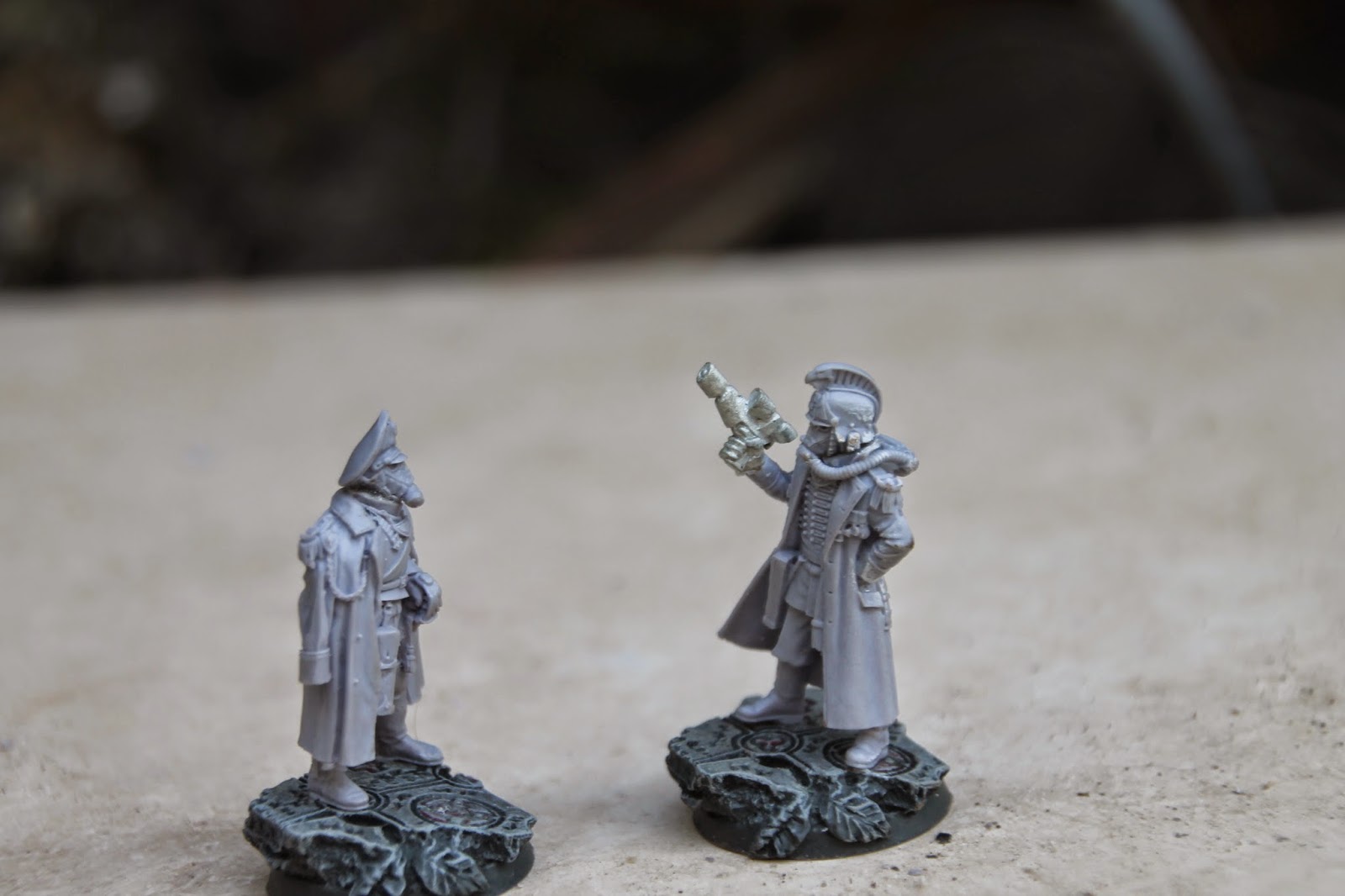
Of course these arn't really new FW figures. Just head swaps.

From the box DKK vox operator and a commissar with a FW cadian gas mask head.
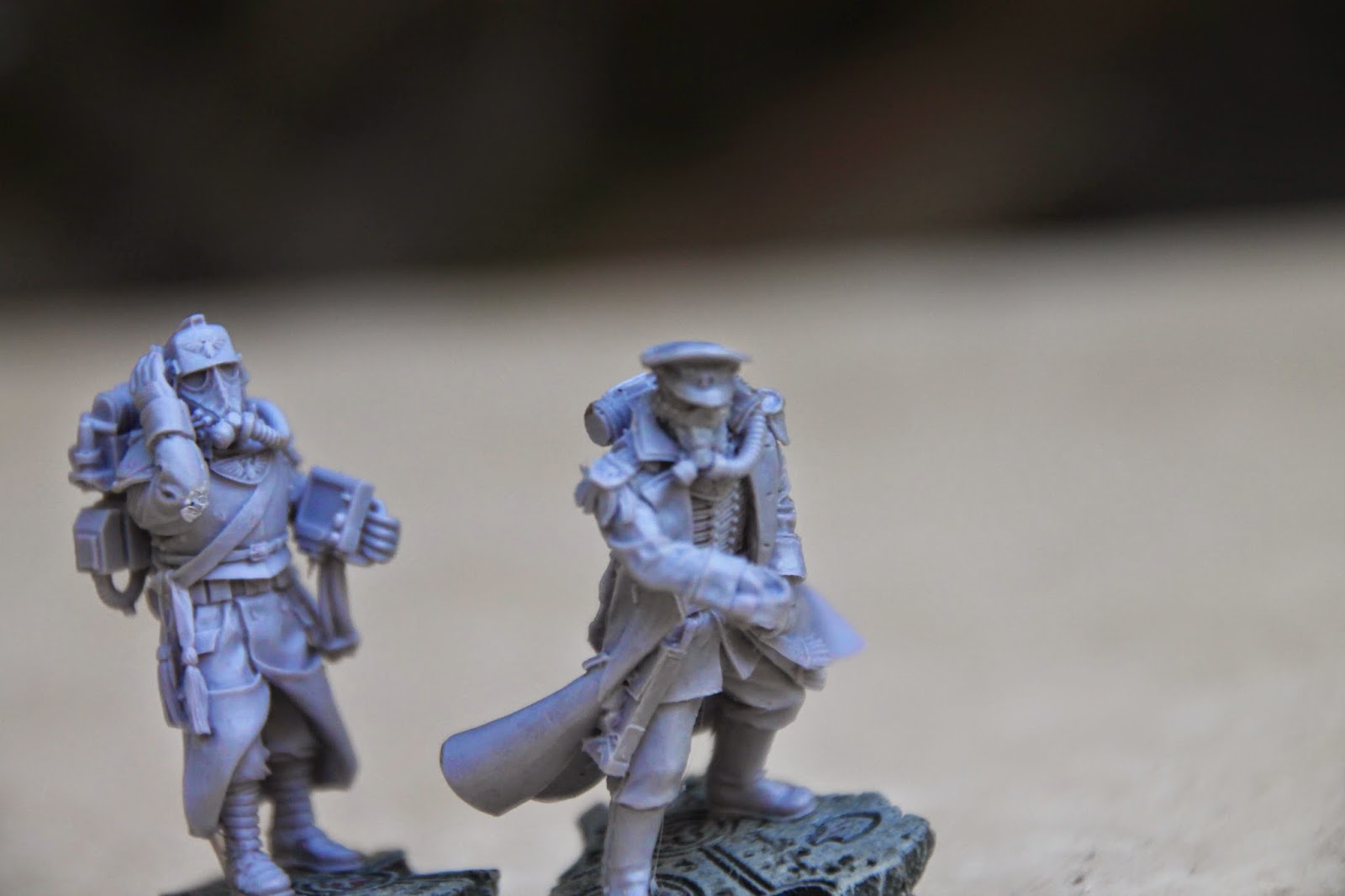
It took several chops to shave the poor ol' head down to a decent fit.

A bodyguard body, commissar head, vicky lamb sword arm, heresy las pistol.

All FW bits. I think these make good officers.

Here they are together, chatting amiably about martyring their regiments for the Emperor. Which is what passes for banter in DKK formations.
Tuesday, 16 September 2014
More Officers.

These fellows are the staff for La Guardia Presedentialae 2nd Devos Regt

With their obligado base toppers and Puppetswar heads.

And the squat form of their orbital defence officer (with his Eisenkarn head).

The guy on the left will be a 13th Mech Regt. He is Catachan bits with a Scion beret head and a flagellant's torch arm.
The guy on the right with the gangsta plasma pistol will be in USMC dress uniform. Jus' because.
Friday, 12 September 2014
More Bloodcoat Officers.

General ("Danny Bloodcoat") Horpan (Scion Officer with Puppetswar head) and his attendant vox officer (scion vox, cadian legs and Pig Iron head). The base topper under Danny B is a freebie from someone somewhere.

Captain bitzbox, Admiral Nelsonx and Tacticae Napoleonx. The resin bases, like the base topper under Nelson were freebies from somewhere. I've had them ages and thought they needed using.

Captain Bitzbox is an Iggy tank commanders head, cadian arms, torso cut from a wargames factory greatcoat body. And pig iron legs. Not quite the stylish sculpt the other two are, but he has character.

And this guy is in there as well. But I can't get his sword arm to stay on, So this is picture from t'interweb.
These fellows are of course the high command types for the Bloodcoats.
Tuesday, 9 September 2014
Late war account from the rebel side.
Bare concrete ceilings arched across large but not vast
spans. Cavernous halls, some with triple bunkbeds and some with boxes of
stores, stretched away for several hundred meters. Naked bulbs hung on their wires, casting a
harsh, uncompromising light on the bodies pressed together within. Occasionally sirens in other parts of the
city would wail and the lights would go off, at these times, everyone would
hush, as if the bombers flying overhead might hear their individual pleas or
curses.
The atmosphere inside the building was close and subtly
uncomfortable. The shelters had been
built with a functioning Heating, Ventilation and Air Conditioning system, but
it was geared for only an eighth of the people now in it and during the war,
parts of it had been cannibalised for higher priority things like AFVs and
Airframes. It struggled audibly and
subjected the inmates to occasional wild variations in temperature and
humidity; Not so bad that everyone inside felt as if they were being
suffocated, but more as if there were not enough air circulating within for the
number of people using it; Various groups were trying to work without being too
disturbing to their neighbours, but this resulted in a constant ululating hum
that added to the headache inducing atmosphere.
It was a vast improvement, nonetheless, on the chaos of the
previous month. Bombarded urban areas
had proved effective as temporary bunkers when immediately assaulted by the enemy,
but protracted fighting amongst the smashed infrastructure meant that sub units
might be sat over trapped gas pockets, an uncomfortable feeling when being
mortared. Every scrape, hollow and
foxhole was as likely to fill with furnace fuel oil or sewerage as it was with
rainwater. And units could not
effectively be supplied, controlled or extracted once the tenuous communication
links were broken.
And the enemy had firepower to spare. Their apparently inexhaustible infantry (in
both senses) were well supported by armour and field artillery. Their Heavy Artillery was never too far away
and they appeared to enjoy complete air superiority. Deliberate assaults on defended positions
might take out a tank or two and could catch their infantry in a crossfire or
enfilade if preparation time allowed, but the enemy’s preparatory bombardment
was always greater.
There seemed to be a constant close air patrol of fighter
bombers or Vultures covering them, even when things seemed to be going well.
Eventually, hiding in the ruins of the small villages
obliterated along their route of march was recognised as merely providing their
medium bombers and heavy artillery with target practice. At the outset of the rainy season, defensive
operations had switched to rural deployments.
Shattered formations had precious little time to regroup before the
enemy armoured recce and cavalry began fanning out and hunting them down.
Again, as soon as any contact was made, the invaders
withdrew to a safe distance whilst their close air support engaged troops dug
into hasty positions in soft earth. On
rare occasions, a brave T-65 pilot would hedgehop into the forward area and
pick off an enemy tank or two before the fighter bombers carelessly jettisoned
their external stores in order to give chase.
It was even rarer for the lone T-65 pilot to make it back. But this show of defiance was good for
morale and showed that the invaders were not invulnerable.
Abandoning position after position meant that within two
months the defenders had lost all of their heavy weapons, vehicles, support
services and to-hand supplies. They were
either living off the land or looting what was left in the shattered towns and
villages. Generally speaking they were
low on ammunition, their main weapon was now the booby trap or hasty
minefield. Their formations and units
were broken and scattered. However, the
lack of cohesion meant that groups the invaders did catch were small and unable
to reveal anything of use.
Eventually, the general order was given for all remaining
formations to re-group for re-deployment to the Capital. As sub units met in the dark confusion
reigned. The enemy was keen to disrupt
any re-grouping and would drop commandos to attack the temporary camps in the
dark; men would flail in the mud and loose weapons and ammunition; tents would
collapse, everything sank into the mud.
People close to the limits of their endurance would only move because
others crashed into them.
The previous years of training of the regular cadres and the
preparedness of the militia made a huge difference when it came to escaping the
camps and marching, wading, through the night only to sink back into mud,
sleeping wrapped in sodden tents when they were far enough away; but they had
got away, even if they had lost everything.
Not only weapons and ammunition, but all sorts of mundane but important
equipment was lost between the urban warfare, the flight through the mud and
the eventual re-deployment in Xyphonica.
Only the foresightedness of Planetary Command in pre-pacing
hidden bomb proof shelters and arms caches (and other supply dumps) meant that
the remaining defenders were still armed. Tired dirty men, some still with mud
in their ears and noses, were re-armed before they were fed or allowed to rest.
The vast reinforced bunkers were originally intended to
shelter the civilian population from air raids, but most civilians had fled the
city. And besides, the enemy had amply
demonstrated that this was a genocidal war – the distinction between combatant
and non-combatant had long since lost any meaning.
At such strong points across the city, the defenders waited
with increasing disquiet. The nightly
air raids were smashing the infrastructure; water, power and heating were no
longer to be taken for granted. In some
places, it was only the foresight that re-laid the cities utilities as district
cells that meant that those places had any services at all. After three years of war, the hospitals were
all but out of drugs and other medical supplies. In some districts, there was no way through
for vehicles due to collapsed buildings.
Fires, where they were, raged unchecked. Casualties were fortunate indeed to be taken
to one of the non-functioning hospitals.
The writing was quite obviously on the wall, if they did not get help
from somewhere soon, the invaders would reduce the city and overrun the ruins.
Tuesday, 2 September 2014
Is there a plan for when we've won ?
The aftermath of the war is something that Comptroller
Bellormus has considered. One of the war
aims of the Devos IV Campaign is to preserve, as far as reasonably practicable,
the food producing capability of the planet.
The loyalist continent of Acer had seen some pro separatist
riots before hostilities broke out, but the agitators have all been interred by
the secret police. There were a few
sporadic air raids, but these amounted to little more than harassment. There were a series of localised fights and
interventions at the North Eastern seaport of Bruboxvillie, which whilst
serious in themselves, posed no real threat to the success of the campaign.
The population of Acer remains largely intact, indeed, has
raised three regiments for the Imperial Guard.
The Imperial census for Devos IV estimated a population of approaching
twenty millions. Comptroller Bellormus’
reckoning made it more like eight millions.
Food production in the seas around Acer continues largely
unaffected by the war, manufacturing and processing on Acer remains the focus
of the remaining population. What has
suffered is the herding culture and cattle towns (abattoirs and freeze drying
plants) as the Imperial Guard pursues a scorched earth policy in its advance
across the rebellious continent of Benq.
Along with the stated aim of destruction of the historical planetary
capital, this has caused Comptroller Bellormus to exclude what survivors there
might possibly be from his calculations.
With the sanction, endorsement, backing and instruction of
the Ordo Hereticus, upon whose behalf this war of liberation was launched,
Comptroller Bellormus has suggested that in answer to overcrowding on a hive
world, a number of persons be displaced in order to ease the congestion; these
people could be sent to Devos IV to assist re-building the population with
Emperor fearing loyal citizens, perhaps even with a long term view to restoring
the population to its census level.
He briefly flirted with the idea of suggesting that the lift
fleet might do some of the fetching and carrying, but in truth, the military
capability was already committed.
The Governor of Palladia immediately saw an
opportunity. He might not be able to export any of the population of Edethor – doubtless they were too well known as a
rebellious, fractious mob. But he could
make some space; financial incentives to all parties, some bigger than others,
would, in the medium and long term, be compensated for through taxation. And a social restructure in a Hive Cluster
would be an excuse a reason to restructure the tax system. And so the Danter Hive cluster lost fourteen
and a half million souls[1] in the
space of a fortnight. These people were
loaded up into the fleet of a rogue trader consortium, contractually arranged
for the very purpose.
Effectively then refugees within their own Imperium, these
fourteen and a half million hive worlders would be delivered in just eighteen
months to a world that needed them, but was in no way ready for them. And quite frankly, they were in no way ready
for it. There would be a programme of
training and indoctrination during the voyage, but being part financed by the
Ecclesiasty, it was devotional in tone and content, not of practical value.
Such are the vagaries of the Warp that Comptroller Bellormus
would never receive the astropathic message informing him of these events. The message was eventually received by the
Devos XII astropath station six standard years after Comptroller Bellormus' death many light years away
on Hydraphur; but that would be decades into the future. When the immigrants arrived, it was
a bit of surprise. The Imperial Navy
intercepted the fleet at the edge of the system and signalled Imperial High
Command. Effectively, there were then
two weeks, whilst the fleet transited real space, to prepare for their arrival.
Fortunately by that time, the war was all but over. And as a food producer with established supply routes and good space faring connections, the resulting humanitarian plight was a shadow of what it could have been; The departmento had already created infrastructure and supply chains dirtside that would cope with the influx and by keeping control of how many were migrated, at what rate and to which locations, the first migrants were already net contributors before half of them had set foot on their new world. It took three years before the last of the consortium fleet left the Devos system.
[1]
Out of 2.1 Billion across six hives. It
might not seem much, but would allow the Hive rulers enough wriggle room in
terms of socio-economic policy changes to stave off a major block war for
another decade and a half.
Subscribe to:
Posts (Atom)